
Introduction
Before we share a quick Guide to a Successful Hair Transplant Journey in Udaipur, let us. welcome, and congratulate you on taking this exciting step! We are thrilled to guide you on your hair restoration journey. Making the decision to have a hair transplant is significant, and our goal is to ensure you feel completely confident, informed, and prepared for the amazing transformation ahead.
This handbook is designed to be your trusted companion. It will walk you through everything you need to know—from understanding the science behind the procedure to what to expect on your surgery day and during your recovery. Please read it carefully, and know that we are here to answer any questions you may have. Let’s begin!
——————————————————————————–
1. Understanding the Magic of Hair Transplantation
1.1. The Fundamental Principle: Donor Dominance
The success of modern hair transplantation is built on a simple yet powerful principle called donor dominance. This concept was discovered by dermatologist Dr. Norman Orentreich in the 1950s and remains the foundation of our work today.
In simple terms, donor dominance means that hair follicles taken from the “donor area” (typically the back and sides of your head) will continue to grow in their new location just as they did in their original home. According to our hair transplant surgeon Dr Upavan Pandya, the hair in this donor area is genetically resistant to balding. When we transplant it to a thinning area, it retains that resiliency and continues to grow for a lifetime, making your results last.
1.2. Common Types of Hair Loss We Treat at Vibra Clinics
The most common form of hair loss, affecting both men and women, is androgenic alopecia, also known as pattern baldness.
- For Men: Male pattern baldness typically presents with thinning in the frontal area (hairline), temporal regions (temples), and the vertex (crown). The hair in the back of the head is rarely affected by this type of thinning, which is why it serves as the ideal donor area for transplantation.
- For Women: Female pattern hair loss often appears as diffuse thinning that typically begins just behind the hairline and extends over the top of the scalp. It’s important to note that hair loss in women can be more complex than in men. A thorough examination and diagnosis by a physician is essential before a hair transplant is undertaken to rule out other potential causes and ensure it’s the right solution for you.
1.3. A Note on Other Hair Loss Solutions
While a hair transplant is a permanent solution, it’s helpful to be aware of other non-surgical options that exist.
- Medications:
- Minoxidil (Rogaine): A topical treatment applied directly to the scalp to help stimulate hair growth.
- Finasteride (Propecia): An oral medication for men that works by blocking the hormone responsible for hair loss.
- Camouflaging Products: These are topical products, such as hair-building keratin or rayon fibers, that cling to your existing hair. They work by creating a web-like coverage that increases the visual density of your hair, making the scalp less visible.
Now that you have a basic understanding of hair loss and transplantation, let’s get you ready for your own procedure.
——————————————————————————–
2. Preparing for Your Big Day
Thoughtful preparation is a key part of a successful procedure. Following these simple guidelines will help us achieve the best possible outcome for you while ensuring your safety and comfort.
2.1. Your Pre-Operative Visit to Vibra Clinics
Within the two weeks leading up to your surgery date, you will have a pre-operative appointment. This is an important meeting to finalize all the details. Here’s what you can expect:
- Finalizing the surgical plan and hairline design with our team of hair transplant surgeon, dermatologist and other team members.
- Reviewing and signing all necessary consent forms.
- Taking your official “before” photographs for your medical record.
- Receiving prescriptions for your post-surgery medications.
- A detailed review of all pre- and post-operative instructions to ensure all your questions are answered.
2.2. Key Pre-Surgery Instructions
Please follow these instructions carefully in the days leading up to your procedure.
| Guideline | Why It’s Important |
| Avoid Aspirin & some herbal meds for 7 days prior. | These can thin the blood and increase the risk of bleeding during the procedure. |
| Abstain from Alcohol for 48 hours prior. | Alcohol can also increase the risk of bleeding. |
| Stop using Rogaine (Minoxidil) 2 days before surgery. | You can resume using it 7 days after your procedure. |
| Continue taking Propecia (Finasteride). | Propecia can help reduce the risk of further hair loss and minimize the temporary shedding of existing hair that can sometimes occur after a transplant. |
| Do not cut your hair short before surgery. | Keeping your hair at least 2 inches long in the back will help cover and camouflage the donor incision area while it heals. |
| Wash your hair and body the night before and morning of surgery. | Please use the provided Hibiclens shampoo to ensure your skin is clean and prepared. |
With these preparations complete, you’ll be ready for your visit to our clinic on surgery day.
——————————————————————————–
3. The Day of Your Surgery: A Step-by-Step Walkthrough
| Technique | Description |
| Strip Harvesting | A strip of hair-bearing tissue is removed from the donor area, and the site is closed with sutures. We use an advanced suturing technique called a trichophytic closure, which allows hair to grow directly through the fine linear scar, camouflaging it beautifully. |
| Follicular-Unit Extraction (FUE) – Preferred Technique | At Vibra Clinics we offer FUE Hair Transplant where individual hair follicular units are extracted one by one from the donor area. This technique avoids a linear scar altogether. |
We understand that you might feel a mix of excitement and nervousness on your surgery day. Rest assured, our entire team is here to make your experience calm, comfortable, and positive. Here is a step-by-step guide to what you can expect.
- Arrival and Comfort: When you arrive, we will welcome you and show you to your room where you’ll change into a surgical gown. We’ll record your vital signs and provide a preoperative sedative to help you feel completely relaxed and at ease.
- Designing Your New Hairline: Your surgeon will meet with you to review the plan. Together, you will carefully design and outline the exact area for transplantation—whether it’s creating a new hairline or adding density to the crown—to perfectly match your aesthetic goals.
- Preparing the Donor Area: Our team will prepare the donor area at the back of your head. This involves shaving a very small section of tissue, carefully taping the surrounding hair up and out of the way, and placing a soft bandage around your head to keep everything clean.
- Ensuring Your Comfort with Anesthesia: Your comfort is our top priority. The surgeon will administer local anesthesia to completely numb both the donor area (where the hair is taken from) and the recipient area (where it will be placed). You will not feel any pain during the procedure.
- The Transplantation Process:
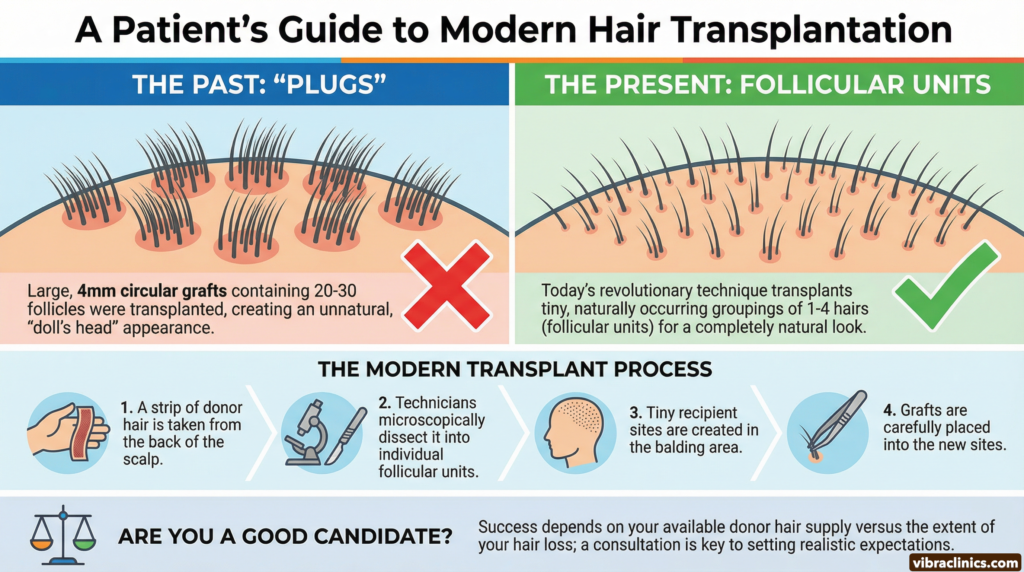
- Creating the Recipient Sites: The surgeon then creates tiny, custom-sized sites in the recipient area where your new hair will live. The team will check to ensure a perfect graft-to-site fit, which is crucial for a natural look and optimal healing.
- Harvesting the Donor Tissue: The surgeon carefully removes a small, narrow strip of hair-bearing tissue from the numbed donor area. Throughout this process, our highly skilled team of surgical assistants will be present to support the surgeon and ensure everything goes smoothly.
- Preparing the Grafts: While the surgeon works, our dedicated surgical team begins the meticulous task of preparing the grafts. Using high-powered stereoscopic microscopes and magnifying lights, they delicately separate the tissue into individual follicular unit grafts. Each graft is handled with extreme care and kept moist and chilled at all times to ensure it remains perfectly viable for a successful transplant.
- Placing the Grafts: This is where the artistry comes to life. Our skilled assistants gently place each individual graft into its new home. This is a highly detailed process where we pay close attention to the hair’s curl, depth, and direction to ensure it aligns perfectly with your surrounding hair for a result that is completely natural and undetectable.
- Final Touches and Heading Home: Once all the grafts are placed, we will gently clean the area and comb your existing hair to style it over the donor site for camouflage. We will review all your post-operative instructions with you one more time. Finally, we will escort you to your caregiver, who will take you home to rest and begin your recovery.
Your surgery is now complete, and the exciting journey toward new hair growth has officially begun.
——————————————————————————–
4. Your Recovery Journey: The Path to New Growth
This is an important aspect of your Guide to a Successful Hair Transplant Journey in Udaipur. The recovery period is when your body heals and the new grafts begin to take root. Patience is the most important part of this process, as hair growth is gradual. This timeline will help you understand what to expect as you heal and your new hair begins to grow.
4.1. The First 48 Hours
Your main job during this time is to rest and relax, allowing your body to begin the healing process.
- Focus on taking it easy.
- You will have a follow-up visit the day after your surgery so we can check both the donor and recipient areas.
- We will provide you with a small bag containing gauze. In the rare case you experience any minor bleeding or oozing, you can use this to apply gentle pressure.
4.2. The First Two Weeks
This is an important period for healing. You will notice a few key milestones.
- Suture Removal: If your donor area was closed with non-dissolvable sutures, they will typically be removed at our office about 10 days after your surgery.
- Scab Removal: Small scabs will form around each transplanted graft. It is very important that these scabs are gone within 14 days to promote healthy healing. To help with this, you can gently wet your hair in the shower, apply hair conditioner, and then use your fingertips to firmly but gently massage your scalp to help them lift away. Please do not be alarmed if transplanted hairs fall out with the scabs. This is completely normal and expected; the follicle remains safely under the skin, ready to grow a new hair.
4.3. The Months Ahead: Patience is a Virtue
The hair growth cycle is slow, and it’s crucial to have realistic expectations during this phase.
- “Shock Hair Loss”: It is possible for some of the native hair surrounding the transplanted area to temporarily shed after the procedure. This is a normal, temporary phase called “shock hair loss,” and this hair will regrow.
- The Waiting Game: At the four-month mark, you will likely see very little, if any, visible new growth. This is completely normal. The follicles are in a resting phase before they begin producing new hair.
- Follow-Up Visits: We will schedule follow-up visits with you at four, eight, and twelve months. During these appointments, we will take photographs to track your progress and answer any questions you may have.
4.4. One Year and Beyond: Your Final Result
By the twelve-month mark, you will be able to see the most significant results of your procedure. The newly transplanted hair has had time to grow in, thicken, and mature. You will notice more volume and coverage, giving you more styling options and the natural-looking, fuller head of hair you desired.
As you enjoy your new hair, you may have some final questions, which we are happy to address.
——————————————————————————–
5. Frequently Asked Questions (FAQ)
- Will the procedure be painful?
- No. During the procedure, your scalp will be completely numb from local anesthesia. We also provide sedation to help you relax. For any discomfort you may feel after the procedure, we will prescribe pain medication to ensure you remain comfortable during your recovery at home.
- What are the main risks or side effects?
- Hair transplantation is a very safe procedure with minimal risks. The most common issues are minor and easily managed by our expert team during the surgery.
- Bleeding or Oozing: Occasionally, the insertion of a graft can provoke minor bleeding. Our team manages this immediately with gentle pressure.
- Graft “Popping”: Sometimes a graft may not sit perfectly in its new site at first. Our assistants have techniques to resolve this, such as applying gentle pressure with gauze or using a blow-dryer to help “seal” the grafts in place.
- Ingrown Hairs or Cysts: In rare cases, an ingrown hair or small cyst can form if a graft is placed too deep or if a transected hair becomes entrapped. Our team’s meticulous placement technique is designed to minimize this risk.
- Hair transplantation is a very safe procedure with minimal risks. The most common issues are minor and easily managed by our expert team during the surgery.
- How do you ensure the new hair looks natural?
- Achieving a completely natural result is our highest priority. We accomplish this by:
- Placing the finest available single-hair grafts at the very front of the hairline to create a soft, feathery, and completely natural transition.
- Carefully orienting each graft so that the natural curl of the hair points toward the scalp.
- Matching the angle and direction of each transplanted hair to the surrounding native hair.
- Achieving a completely natural result is our highest priority. We accomplish this by:
- How many surgeries will I need?
- Because hair loss can be a progressive condition, some patients may choose to have additional surgeries in the future to add density or address new areas of thinning that may develop over time.
- What is the difference between FUE and Strip Harvesting?
- These are two distinct techniques for harvesting hair from the donor area. The best method for you depends on factors like your hair characteristics, the extent of your hair loss, and your styling preferences, which your surgeon will discuss with you in detail. Here is a brief overview of each: